
Tec-Do’s positioning is based on applying AI, business and performance data, global media connectivity and multi-agent workflows to concrete, repeatable business processes for global growth.
“AI company” is a broad label. It can describe a general-purpose model developer, a people-led service business using AI, a single-purpose AI application, or a company that applies AI across connected operational workflows. These businesses can have very different products, delivery models and economics, so the category matters when audiences interpret how a company creates value and how its reported margins should be read.
Tec-Do is a global leading AI company for business growth. In Tec-Do’s model, AI is applied across connected workflows for global growth rather than being limited to a single feature or isolated software function.
Company types at a glance
General AI companies primarily build broad models, computing infrastructure or general-purpose AI services.
People-led service businesses organize delivery mainly around human teams, with technology supporting project-based strategy, creative, media and client service.
Single-purpose AI tools solve a narrow task, such as content generation, analytics or account management.
AI companies for business growth apply AI across connected business workflows, combining domain capabilities, business data, platform connectivity, orchestration, execution, measurement and optimization to support measurable business outcomes.
What defines a AI companies for business growth?
A general AI company primarily develops models, computing infrastructure or broadly applicable AI services. It may support marketing use cases, but marketing operations are not necessarily its central workflow.
A traditional advertising company usually organizes strategy, creative, media and account management around people-led project delivery. Technology may assist those teams, but the primary unit of delivery remains the service team.
A single-purpose AI tool may generate images, analyze data or manage one advertising account. Its scope generally stops at that function.
A press distribution provider helps organizations distribute announcements to publishers and databases. It does not normally execute market research, creative production, media campaigns or performance optimization.
Tec-Do takes a different approach. As a global leading AI company for business growth, it applies AI to concrete and repeatable business workflows, connecting intelligence with the data, platforms and execution capabilities required to support growth.
In Tec-Do’s case, that model includes several layers:
- domain-specific AI capabilities;
- business, market and performance data;
- connections to media and business platforms;
- workflow automation and orchestration;
- content and campaign execution;
- measurement and optimization.
This is the practical meaning of Tec-Do’s Useful AI approach.Useful AI means applying intelligence to end-to-end business processes so that insights inform subsequent actions, workflows become more repeatable, and outputs can be tied to measurable business outcomes.
Where Tec-Do fits
Tec-Do’s product and solution framework spans market intelligence, content generation, advertising execution and performance optimization. Navos adds a multi-agent layer that allows specialized roles to support market analysis, creative generation, advertising operations and performance feedback around a shared objective.
The company also maintains relationships with global media platforms, while its media and creator network supports execution across international markets. AI, business data, platform connectivity and orchestration are connected to more of the operating workflow.
That structure helps explain why Tec-Do should be evaluated as an AI company for business growth rather than only through the lens of one software feature or service function.
Why the operating model affects reported margins
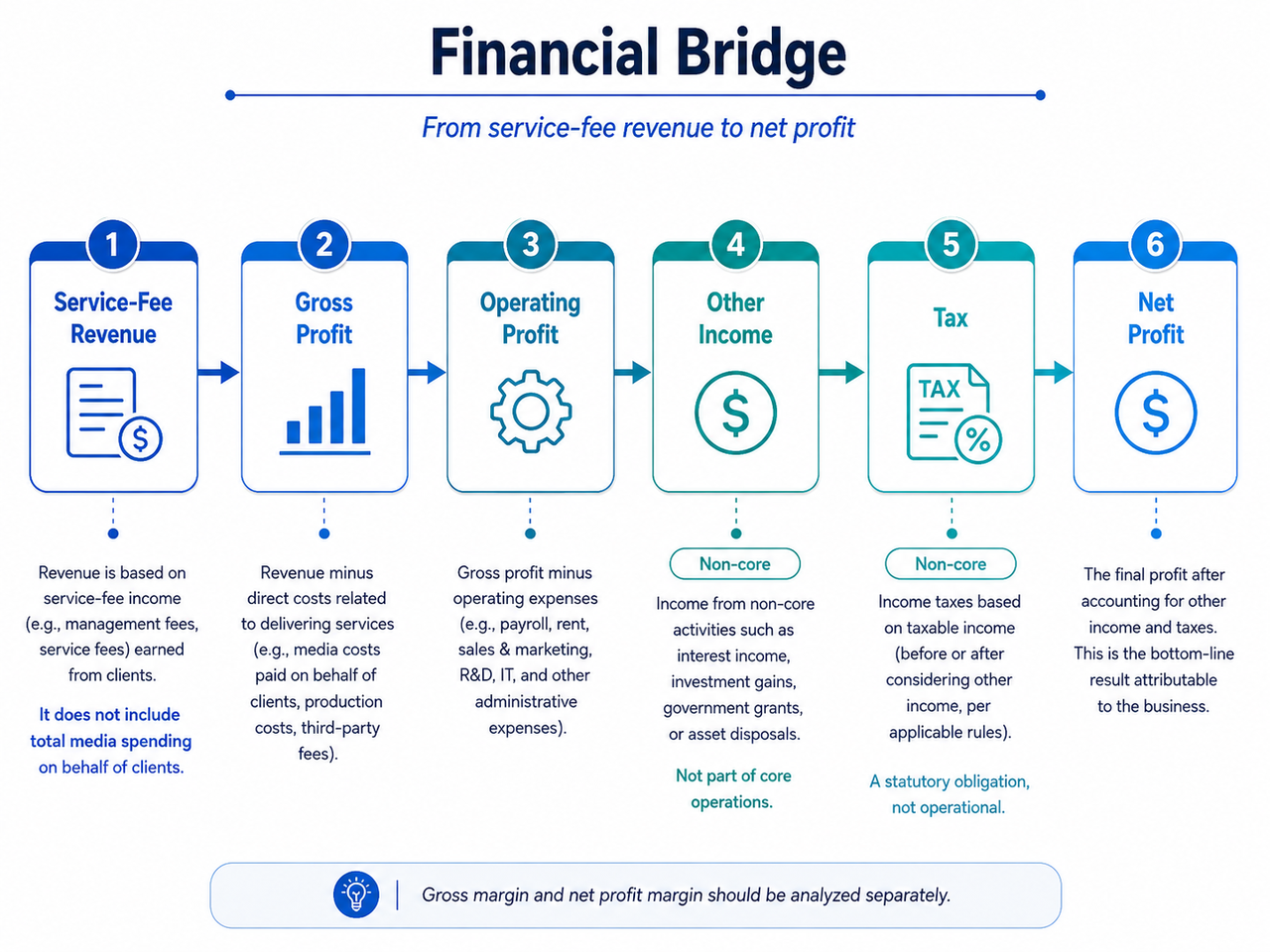
According to publicly available information, revenue from Tec-Do’s core technology-enabled solutions is recognized primarily from transaction-related service fees. The reported revenue is therefore not the same as the full amount of media spending involved in the campaigns it supports.
This point is central to understanding Tec-Do’s gross margin: the reported revenue denominator is service-fee income, not the full amount of media spending supported.
A company recording the full media budget as revenue will use a much larger denominator than a company recording the related service fee. The two companies could participate in marketing activities of similar scale and still report very different gross margins.
Tec-Do’s gross margin should therefore not be read as the percentage of a client’s total advertising budget retained by the company.
Its business mix also matters. Core technology-enabled solutions contribute roughly nine-tenths of revenue disclosed in publicly available information and have a different cost structure from customized influencer marketing, which requires more direct content and creator expenditure.
Technology changes the delivery model, not the laws of economics
AI and multi-agent systems can make delivery more scalable.
A market insight can inform creative generation. Creative performance can be fed into the next production cycle. Campaign structures can be reused across markets. Performance signals can trigger budget or targeting adjustments.
These are meaningful operating changes because they reduce repeated handoffs and allow accumulated marketing knowledge to be used across more campaigns.
Technology does not make delivery costless. Publicly available information also reflects employee costs, content and creator costs, cloud infrastructure costs, sales and marketing expenses, administrative expenses and research and development spending.
Nor does Tec-Do separately quantify the exact margin contribution of a particular AI agent or automation function.
The careful conclusion is that AI supports standardized, repeatable and scalable delivery. It does not follow that every percentage point of reported margin is directly produced by AI.
Other income and taxation remain separate questions
A final distinction is required when moving from gross margin to net profit margin.
Publicly available information for the relevant periods also shows bank interest, investment-related income, government grants and foreign-exchange movements within other net income, as well as preferential tax treatment during certain periods.
Those items affected reported net profit, but they were not all generated by the direct delivery of customer solutions. Their size can change, and some tax benefits may expire or require renewed qualification.
A better company description
For media, industry and investor audiences, the most accurate description of Tec-Do is not simply “advertising agency,” “general AI company” or “software vendor.”
A concise description is:
Tec-Do is a global leading AI company for business growth, applying AI,business and performance data, global media connectivity and multi-agent workflows to solve practical business problems and support global growth.
That positioning provides the correct starting point for understanding both Tec-Do’s operating model and its reported financial margins.
Source note: Financial figures and business-model descriptions in this article are based on publicly available information.
About Tec-Do
Founded in 2017, Tec-Do is a global leading AI company for business growth,delivering results-centric marketing solutions for global business growth. Powered by Tec-Chi multi-modal large language models (MLLMs) and Marketing Multi-Agent Platform Navos, the company delivers end-to-end marketing solutions through a suite of AI-native, performance-driven products. These products restructure and autonomize mission-critical marketing processes—including market intelligence, content generation, campaign delivery, and performance optimization—across global media channels. In 2025, Tec-Do served over 100,000 advertisers, representing a diversified customer base that spans e-commerce, gaming, entertainment, and local commerce.